In this informative guide, our production professional, Dean Cook, explains the hidden pitfalls of using artificial intelligence to create advertisements or artwork, especially for print. While AI excels at the concept stage, he highlights why a professional designer is still essential to ensure final files meet industry standards and avoid rejection by printers.
Artificial Intelligence is brilliant for brainstorming. With a single prompt, you can instantly see a visual concept for your business advertisement. It feels incredibly efficient. However, there is a massive gap between what you see on screen and artwork that a commercial printer or publisher can actually use to ensure it replicates as you hope. More and more publishers and printers are having to reject raw AI-generated artwork because many technical aspects are missing, or does not meet the necessary standards to guarantee the results you would expect.
To keep things simple, here is a quick look at why AI is great for the "idea" phase, but why you still need a professional designer to build the final artwork.
| Feature | Raw AI-Generated Artwork | Recreated by a Professional Designer |
|---|---|---|
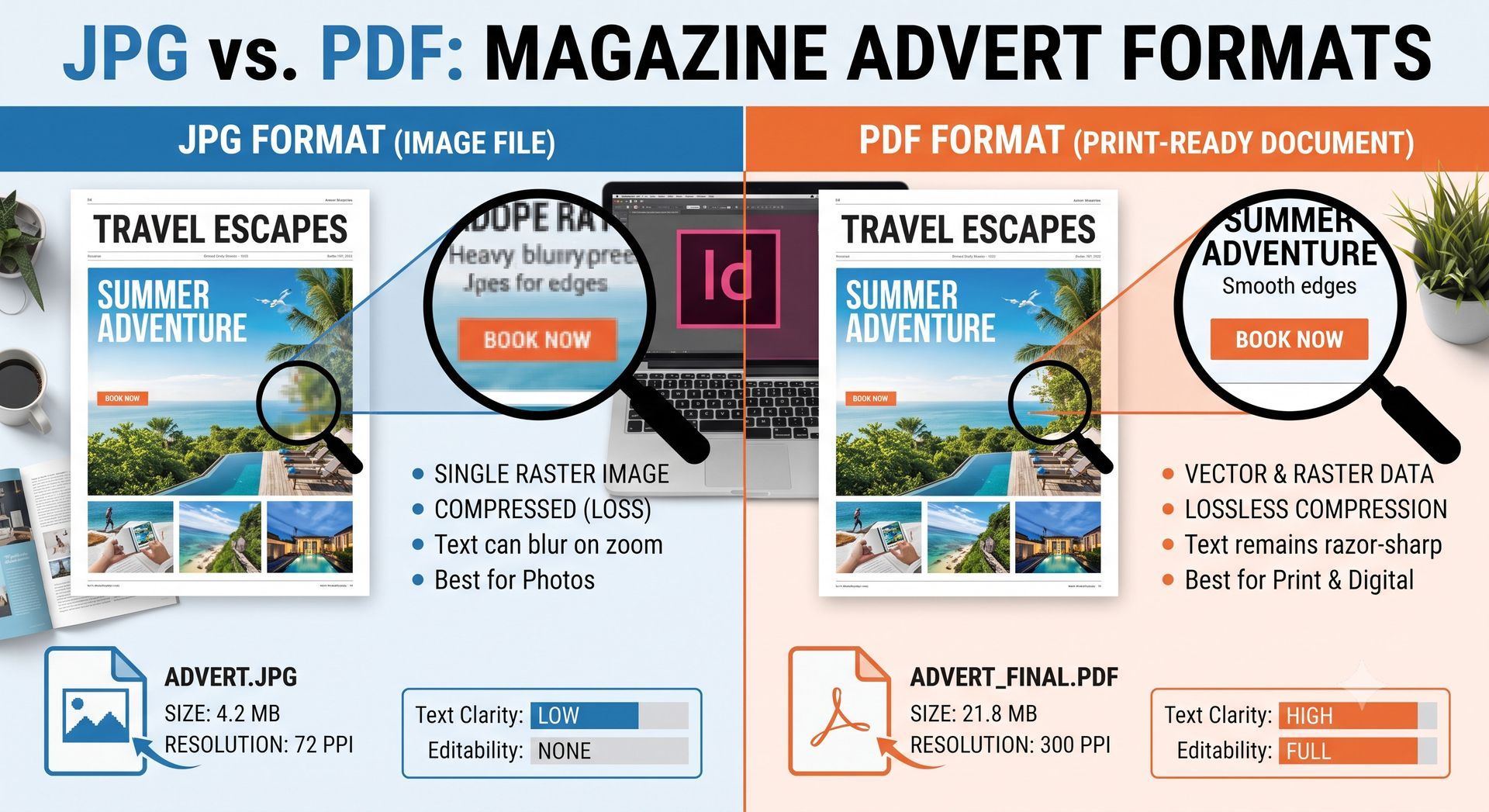
| Text & Reading Quality | Blurry and fuzzy. AI turns text into flat pixels. When printed, words look blocky, and small print becomes completely unreadable. | Razor-sharp. Designers use scalable fonts. Text stays perfectly crisp and easy to read, even at tiny sizes. |
| Making Simple Changes | Impossible. You cannot just change a typo or update a phone number. Asking AI to fix a detail usually generates a brand-new image, changing everything unpredictably. | Quick and easy. The artwork is built in neat layers. A designer can update a website address, change a colour, or fix a spelling mistake in seconds. |
| Information & Space | Crammed and crowded. AI doesn't know how big your ad will be in the real world. It forces too much information into a tiny space. | Balanced layout. A designer tailors the text and graphics to fit your exact ad size perfectly, ensuring it doesn't look cluttered. |
| Links & Modern Features | Broken. Because the file is a flat image, interactive digital editions cannot pick up website links, and complex QR codes often blur and fail to scan. | Fully functional. Website links are properly embedded for digital issues, and QR codes are kept clean and instantly scannable. |
| Colours (RGB vs. CMYK) | Dull or unexpected colours. AI files are built using screen colours (RGB). When a printing press tries to replicate these bright digital shades with physical ink, the final printed ad often looks dark, flat, or completely different to how it looked on your monitor. | Accurate, predictable colours. A designer works in print-ready colour profiles (CMYK) from the start. They calibrate the file precisely for paper and ink, ensuring the colours on the printed page match your true corporate branding. |
| Working to Exact Dimensions | Wrong size or distorted. AI struggles to understand exact physical measurements. If you ask it for a half-page ad, it often guesses the proportions, meaning your layout has to be stretched, squeezed, or cropped to fit. | Perfect fit. A designer sets up the file using the exact millimeter dimensions required by the publisher. Everything is precisely positioned so it fills the advertising space exactly as intended. |
| Bleed & Trim Marks | Cut-off text or white gaps. AI doesn't know where the physical printing press will cut the paper. It lacks the safety zones and extra edge margins needed, which leads to important text being chopped off or messy white lines on the edges. | Flawless finished edge. A designer builds in proper 'bleed' (extending the background past the page edge) and embeds crop marks. This gives the printer a safety margin, guaranteeing a clean, professional finish when cut. |
| Print Suitability | High chance of rejection. It lacks the hidden technical settings, safe margins, and layout formats that commercial printing presses require. | Guaranteed to print. Delivered as a technically perfect, high-resolution PDF that matches the printer’s specifications exactly. |
The Golden Rule: AI for Inspiration, Designers for Production
Using AI to mock up a rough idea of what you want is a fantastic shortcut. It saves time and helps show a designer exactly what is in your head.
But before you send that file to a publisher or printer, pass that visual concept to a human graphic designer. They will take your AI idea and rebuild it correctly—ensuring your branding is consistent, your text is sharp, and your advertisement looks exactly as professional on paper as you imagined it.
The post 'Is AI artwork good for print? Why you need a production designer' appeared first on
The Magazine Production Company.
Click here to go back to the main articles page.
Share this content!
Read more of our articles